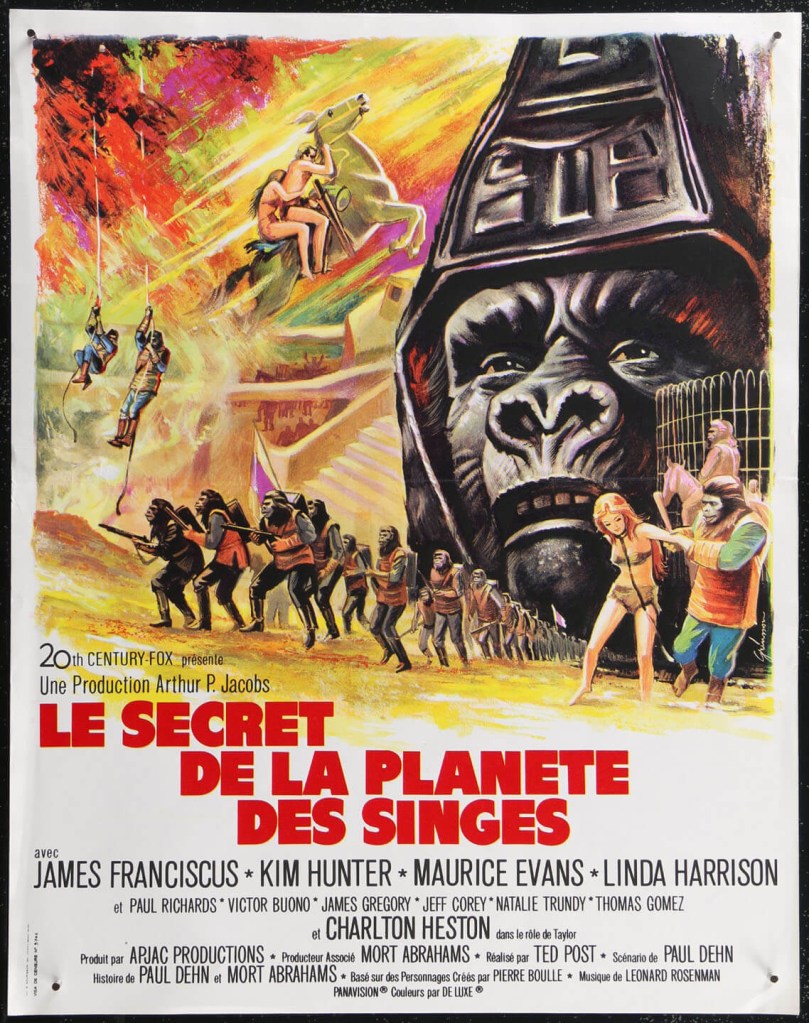
I had to go to France to find a decent poster for it.
There’s no arguing that Planet of the Apes (1968 – Franklin J. Schaffner) is a science fiction classic. It deserves every bit of its reputation.
That said, I’ve always found it a little stuffy. It’s deliberately paced, occasionally preachy, and spends a surprising amount of its running time with Charlton Heston before we really get to what we came to see—the apes. The film is built around ideas more than action, and that’s part of what makes it a classic.
My biggest issue has always been the antagonists. Dr. Zaius and the Orangutan science council aren’t physically intimidating. They’re meant to represent institutional authority, but they often come across like a panel of university professors or math teachers protecting their jobs rather than a regime capable of real brutality. They’re frustrating more than frightening.
The film also has one of the greatest twist endings in cinema history. Ironically, when I first saw it as a kid, I assumed they had landed on Earth in the future almost immediately. The sky was blue, the sun was yellow, the trees looked familiar—it all seemed a little too much like home. Maybe I was just a smarty-pants.
As for Charlton Heston, I know he was one of the biggest stars of the era, and I’ve seen him in everything from Soylent Green to the disaster movies. My problem has always been that he seems to play the same character: angry, cynical, and always ready to explain why whatever optimism you have is misplaced. He’s certainly compelling, but rarely the most likable person in the room.
Which brings me to Beneath the Planet of the Apes (1970 – Ted Post), my favorite film in the series.
The biggest advantage is that it doesn’t have to spend half an hour explaining its premise. We already know we’re on a planet ruled by apes. After a brief recap, the movie gets right to business, introducing astronaut Brent (James Franciscus) as he searches for Taylor and retraces much of his journey alongside Nova.
More importantly, we get apes almost immediately.
Brent’s introduction to Ape City comes during General Ursus’ fiery speech, and James Gregory gives the series the intimidating villain it needed. Unlike the intellectual Dr. Zaius, Ursus is a military dictator whose solution to every problem is violence. His determination to exterminate humanity gives the story urgency the original intentionally avoids. Time is running out, and everyone knows it.
The sequel also expands the world instead of simply repeating it. In the first film, the Forbidden Zone is little more than a mysterious wasteland. Here it becomes something far more fascinating, hiding the ruins of New York and an underground civilization of telepathic humans horribly deformed by radiation from the first atomic war. It’s a wonderfully imaginative piece of science fiction that broadens the mythology instead of recycling it.
Despite having only about half the budget of the original, Beneath makes excellent use of what it has. The matte paintings, ruined subway tunnels, underground cathedral, and mutant city give the film a visual variety missing from the first movie’s largely desert landscapes and Ape City.
The film even finds room for lighter moments. Seeing Zira and Cornelius at home gives ape society some welcome personality, while Zaius and Ursus discussing military strategy in a sauna remains one of the series’ strangest—and most entertaining—scenes.
Perhaps what I enjoy most is the film’s pacing. The original is a thoughtful science fiction classic that asks big philosophical questions. Beneath is more of an adventure. It keeps the story moving, continually introduces new ideas, and never feels content to simply repeat what came before.
And then there’s the ending. Instead of restoring the status quo, the film ends by destroying the entire world. It’s one of the bleakest finales ever attached to a major Hollywood franchise, and even today it still has the power to shock.
I completely understand why most people consider Planet of the Apes the superior film. It’s unquestionably the more influential and important movie.
But if I’m sitting down to watch an Ape film for pure entertainment, I’m reaching for Beneath the Planet of the Apes. It’s faster, stranger, more imaginative, has a genuinely formidable villain, expands the mythology in fascinating ways, and never forgets that science fiction should also be fun.
 It's Andy Fish!
Leave a comment